Rodin Works: Monument to victor hugo |
|||
|
In 1889, Rodin was invited to create a 'Monument
to Victor Hugo', to be positioned at the north transept of the
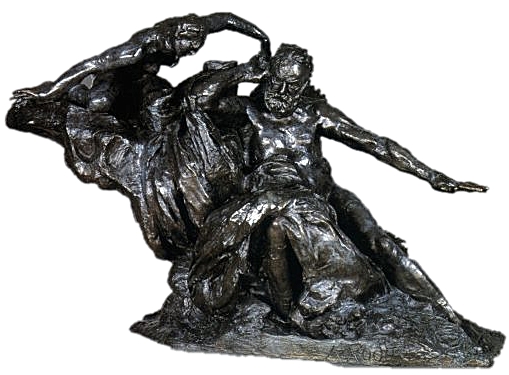
Panthéon in a large setting comprising 100 sculptures. As Rodin started to give more room to these Muses - originally closely flocked together behind Hugo's back - and his design thus was developing in a horizontal rather than vertical direction, the committee concluded Rodin´s proposal would not harmonize with the 'Monument to Mirabeau' by Injalbert, with which it should be matched.
On 19 June 1890, Rodin was asked to develop a standing Victor Hugo for the Panthéon instead, in balance with Injalbert's erect figure; for the seated Victor Hugo, a worthy outside location should be found. For the Panthéon, Rodin now created 'The Apotheosis of Victor Hugo', which was completed by 1891 - but never installed there and only cast as a maquette. The rejection of the seated version offered Rodin the opportunity to re-work his horizontal compostion once more. The sculptor even travelled to Guernsy to taste the air Hugo had breathed there, and kept adapting the figures of the Muses. In 1897, Rodin presented a plaster version in the Salon of the Societé Nationale des Beaux-arts, based on an enlargement by LeBossé, which still looked very provisory: Hugo's arm was supported by a metal pipe, his shoulder ripped, the armature of the 'Tragic Muse' showing through. In Revue des deux mondes, Lafenestre, who had been part of the committee that had rejected Rodin's first proposal, criticised the unfinished work:
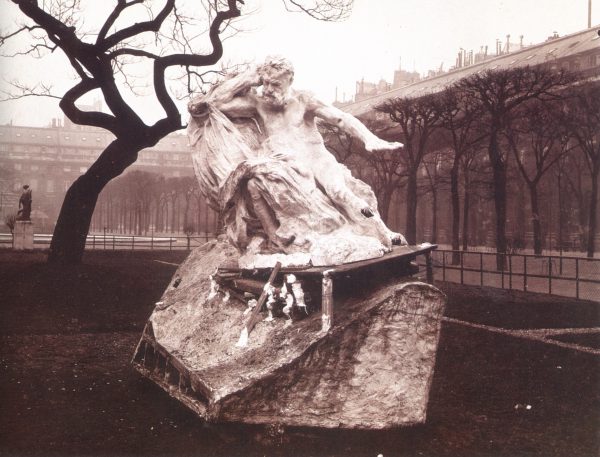
Finally, a marble sculpture of the Poet, resting on the rocks of the island of Guernsy, without Muses, was carved for the Salon of 1901 and, with the support of Dujardin-Beaumetz, placed in the gardens of the Palais-Royal on a pedestal of uneven stone slabs in 1909, where it stayed till 1933; later, it was removed to the Musée Rodin [Butler, Rodin's Monument to Victor Hugo, p. 16f]. Rodin's Project as an execution of Hugo's self-erected monument
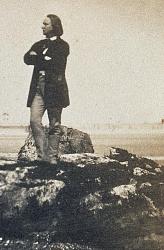
The photos above, made in 1853 during Hugo's exile by his son Charles, must have been familiar to Rodin; Hugo had deliberately directed their shooting as an essential part of his poetic and political message and published them in order to project his own myth. As a consequence, by the time Rodin designed the first version of his 'Monument', the image of the visionary poet, immune to political corruption, listening to the wind, the sea and the voice of the stars (like in Hugo's poem 'Stella') while resting on the Guernsy rocks as his pedestal, already had become a visual commonplace: Le poète est également celui qui éclaire les peuples par la parole, ici la poésie dont le lyrisme s’accorde avec celui des photographies. Ainsi Hugo a-t-il lui-même et consciemment façonné son propre mythe. Dans les décennies suivantes, illustrateurs et caricaturistes réutiliseront l’image de Hugo sur son « piédestal », véritable statue vivante. [Stéphanie CABANNE - read the full article here] In this sense, Rodin's composition was not solely based on his own inspiration, but to a certain degree the execution of the poet's own imagined monument in clay, plaster and marble. The revival of a forgotten Design Rodin's 1897 model sank into oblivion. Only in 1950, when Victor Hugo´s 150th anniversary, the year 1952, was nearing, the City of Paris, looking for a suitable monument, thought of Rodin's attempts again, and commissioned a bronze cast from a model Ruth Butler describes as a: "... three-figure plaster in the Musée Rodin, a
work that had so been out of view for the past fifty years that it was
neither mentioned nor illustrated in the official catalogue of the museum,
a catalogue considered as nearly complete"
|
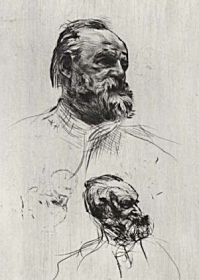 Already in 1883 Rodin received the commission for a portrait bust of the
writer Victor Hugo, who had stayed in exile for 18 years during the reign
of Napoleon III. Since Hugo didn't want to pose as a model, Rodin had to
rely on observations and hastily-made drawings. The marble bust was executed in 1883, two years
before Victor Hugo died.
Already in 1883 Rodin received the commission for a portrait bust of the
writer Victor Hugo, who had stayed in exile for 18 years during the reign
of Napoleon III. Since Hugo didn't want to pose as a model, Rodin had to
rely on observations and hastily-made drawings. The marble bust was executed in 1883, two years
before Victor Hugo died.
 Penelope Curtis, Sculpture 1900-1945 – After Rodin, p. 50ff.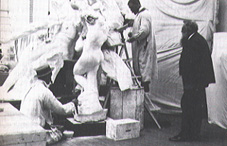
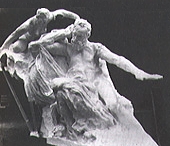 "This
work, in its present state, is nothing more than a piecemeal, incoherent
study, on which it would be premature to pass judgement. The catalogue is
willing to forewarn us that, in this collossal sketch, an arm of a female
figure is incomplete; it is an optimistic catalogue. Oh! If there were
only an arm incomplete! Another arm, it is true, is long beyond measure;
but is that compensation?"
"This
work, in its present state, is nothing more than a piecemeal, incoherent
study, on which it would be premature to pass judgement. The catalogue is
willing to forewarn us that, in this collossal sketch, an arm of a female
figure is incomplete; it is an optimistic catalogue. Oh! If there were
only an arm incomplete! Another arm, it is true, is long beyond measure;
but is that compensation?"